


Briefly
> Cederberg Seduction
> Tour Booking Releases and Updates
> Tech Corner
> Reader's Story
> Featured Pass
CEDERBERG - Into the storm
That first night at Kromrivier things went from hero to zero in the blink of an eye. The pleasant warm weather of the previous day disappeared faster than Greta on a sailboat. There was plenty of firewood on sale, but they were big pieces and one or two pieces of Blitz weren't quite up to Boy Scout standards in terms of successful fire making.
What we needed was tinder. The local bush had little to offer (being at the end of a wet winter) and no-one thought of bringing an axe along. Desperate times called for innovation, as our What's App group came alive with 'how to' methods and remedies to get the fires started. One guest deployed his Leatherman with some success. Some were more successful than others and the desperation ultimately leaned over into the bribery department, with lures of strong liquor being offered as a reward if the 'fire maestros' would come over and help their neighbours!
The mercury plummeted that night, boosted by a howling, gusty north-wester. Those that had booked into the luxury tents had to endure a wild and noisy night, whilst the smug ones in the chalets (including your scribe) slept soundly and warm. Thank heavens there were electric blankets in all the units (including the tents), so no one really got too cold, once they were tucked in.
It was still raining the next morning. On our programme for the day was a visit to Truitjieskraal, Die Stadsaal, San rock paintings and a wine tasting session at Cederberg Wines, scheduled for 12.30. We made a call at 09.30 putting the first three points of interest into the postponed folder, but in lieu of the hectic weather, decided that the wine tasting was the only realistic activity worth doing for the day.
A special Chappies Wolraad Woltemade award to Judy Evans who took a lengthy swim in the main rock pool of the Kromrivier. That river is always ice cold and the imagination runs riot when thinking of just how cold that water must have been after a 2C night plus the wind chill factor All invitations by her to the rest of the group to take the plunge were politely and vehemently declined!
That allowed everyone a relaxed and slow start. We regrouped at reception, destination Cederberg Wines. All that we had to do was drive about 7 km up the Kromrivier Pass and we would be there.
Everything about the winery was professional. Our knowledgeable sommelier welcomed our group of 26 guests and ran an excellent tasting session with flair and a touch of local humour. The large, black farm dog was delighted to get so much love and attention as guests relaxed with the rain pattering down outside.
 Cederberg Winery - the fine art of the vintner / Photo: Trygve Roberts
The dog got me thinking as to why farm dogs are always so relaxed and chilled, compared to city dogs. Farm dogs are often more relaxed and well-adjusted than city dogs due to the natural lifestyle and environment in which they live. On farms, dogs typically have wide open spaces to roam, explore, and exercise freely. This physical freedom allows them to burn off energy, reducing stress and anxiety that many city dogs experience from being confined to small apartments or limited to leash walks.
Additionally, farm dogs often have clear, consistent roles—herding livestock, guarding property, or accompanying farmers. This sense of purpose contributes to mental stimulation and emotional fulfillment, whereas city dogs may become bored or frustrated without such structure. The rural environment also tends to be quieter and less chaotic than urban settings, with fewer overstimulating noises, crowds, or artificial smells that can overwhelm a dog’s senses.

Socialization is also different. Farm dogs often interact naturally with other animals and people in a calm, familiar setting. In contrast, city dogs frequently encounter unfamiliar dogs and strangers in unpredictable ways, which can lead to anxiety or reactivity.
Ultimately, farm dogs benefit from a lifestyle that aligns more closely with a dog’s natural instincts—freedom, purpose, and calm—which helps them develop into more balanced and content companions.
But I digress.
Cederberg Wines did some fair trade as many boxes of their top class wines were loaded into the back of all the SUV's as we set off to return to Kromrivier for a relaxing afternoon in front of the fire (no doubt sampling of the newly acquired vino). At that stage guests had all found means of creating kindling, resolving the problem of getting a good fire going. On next year's tour, kindling will be on the pack lists!
The weather was slowly lifting as we began the descent of the Kromrivier Pass. It was just on the edge of being OK to put the drone up to film the pass. We ushered the convoy past us and took our time setting up the drone and hoped the rain would stay further down the valley, where we could see it falling in wispy grey sheets. The result was better than expected. At 3 min 08 secs in the video have a look how perilously close the drone was to the power lines. So the question is (a) did the drone's obstacle avoidance sensors do what its supposed to do or (b) were we just fabulously lucky?
The restaurant was abuzz with mountain pass energy that night, sitting at a long table with a big fire in the hearth, soaking up the vibe of a wintry night with so many like minded people, in the very heart of the Cederberg. Eventually (the kitchen staff stood in a row silently asking us to go to sleep), we had to call it a night and head back to our digs and get a good night's rest. The wind had eased off and stars had begun appearing, but it was still ice cold. The temperature recorded that night was 2C.
Things were looking promising for the next day, which would involve a lot of driving - Kromrivier, Matjiesrivier, Martiensrus, Eselbank, Wupperthal, Clanwilliam, Algeria and back to Kromrivier - a circular loop taking in much of the diversity of the Cederberg.
We will cover that in our next edition.
TOURS BOOKINGS & UPDATES
We have published the 2026 tours up to and including May. Bookings are now open for the Katberg-Amathole Tour (Feb), Kouga-Baviaans Tour (March), Lesotho (April, already fully booked), and Wild Coast in May. Use the hyperlinks to access full itineraries and pricing.
24 - 30 Nov 2025 - Ben 10 Official - Fully Booked.

15 - 20 Feb 2026 - Amathole-Katberg Tour
With some new routes added this tour is guaranteed to deliver the goods in abundance.

15 - 20 March 2026 - Kouga-Baviaans Tour
After a one year break, we've brought this super tour back. This is the ultimate Baviaans Tour, spiced up with two days in the remote Kouga Wilderness.
 The Baviaanskloof includes plenty of baboons
18 - 27 April 2026 - Mountain Kingdom Tour - Fully Booked.
 Mafika Lisiu Pass summit point at 3091m ASL
19 - 30 May 2026 - Wild Coast Tour
An epic tour over 12 nights / 11 days. There are only 2 places left at time of writing.
 Hydro Electric plant at The Collywobbles
21 - 27 June 2026 - Great Karoo Tour (Bookings open next week)
After the resounding success of the first Karoo Tour, we have added on an extra day to include a visit to Aberdeen and a new finishing point at the Karoo National Park. This tour is not open for booking yet.

24 - 30 July 2026 - Swartberg Classic Tour
This is our most balanced tour and our personal favourite. Bookings will open soon.

6 - 10 September 2026 - Cederberg Spring Tour
We will be running a repeat of this tour. It was so perfect, that we are leaving everything exactly as it is.

23 - 28 November 2026 - Ben 10 Official
The offroad masterclass. Earn the badge!
 Near Joubert's Pass
For the tours after May, we are happy to reserve a 'first refusal' option for you. Just drop us an email with our request and leave the rest to us.
TECHNICAL CORNER
In this issue we are going to address fixing punctures without removing the tyre ujsing sticky string inserts. Most of you have a kit in your vehicle, but do you know how to use it?
Below is a detailed, step‑by‑step guide on how to repair a motor vehicle tyre puncture using sticky inserts (often called “plug kits”, “string plugs”, “mushroom plugs”, or “self‑adhesive inserts”). This method is for tubeless vehicle tyres (cars, light trucks) and is typically a temporary or emergency repair to get you safely to a tyre shop for a permanent fix.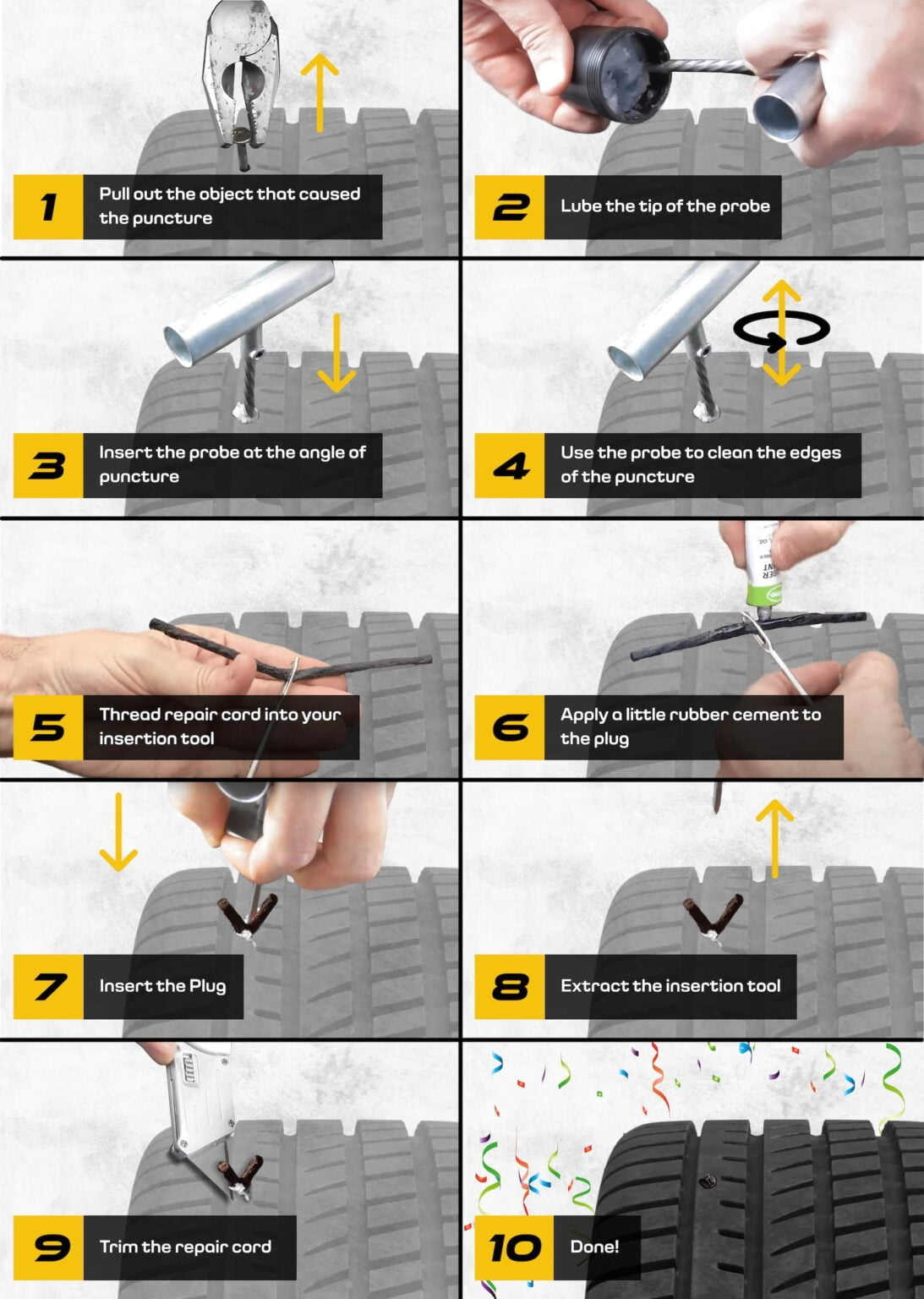
⚠️ Important disclaimers before you start:
-
This method is not suitable for punctures in the tyre sidewall or shoulder. Only the tread area, within the repairable zone, is safe.
-
If the hole is larger than ~ 4 mm, or the tyre has internal damage, you should replace the tyre instead of attempting repair.
-
This is a temporary repair; once repaired, drive cautiously and as soon as possible have the tyre properly inspected and permanently repaired from the inside (patch + plug or “hot vulcanized” repair).
-
Always adhere to instructions from your specific repair kit.
What you’ll need (tools & materials)
-
Tyre plug / sticky insert kit (often includes: plug strips, plug insertion tool, reamer / rasp tool, adhesive / lubricant)
-
Pliers (to remove nail or debris)
-
Tyre pressure gauge
-
Air compressor, portable tyre inflator (12 V pump) or another air source
-
Soap + water spray or soapy solution (for leak testing)
-
Gloves and safety eyewear
-
Chalk, marker, or tape to mark puncture location
-
Jack and wheel chocks (if necessary to access tyre safely)
Step‑by‑step repair procedure (plug / sticky insert method)
1. Put the vehicle in a safe position
-
Park off the road, in a safe, level place.
-
Engage parking brake, put gear in “Park” (or in gear for manual), and switch off engine.
-
Use wheel chocks on opposite wheels to prevent movement.
-
If required, jack up the vehicle and remove the wheel to gain safer access (though many plug repairs can be done with the tyre mounted)
2. Locate and inspect the puncture
-
Rotate the tyre slowly (or roll the car a little) while listening or spraying soapy water to find escaping air bubbles.
-
Mark the puncture on the tyre surface with chalk or marker so you don’t lose track.
-
Inspect the exterior and interior (if wheel removed) for embedded objects (nails, screws, shards).
-
Do not remove the object yet (unless the tyre is fully deflated), as it may help slow the air loss.
3. Remove the piercing object (if possible)
-
Using pliers, carefully pull out the nail, screw, or foreign object.
-
Keep your grip and remove straight out without enlarging the hole.
-
Once removed, the tyre will start losing air (if it hasn’t already).
4. Ream / prepare the puncture hole
-
Use the reamer / rasp tool from your kit (sometimes T-handle spiral probe) to clean and enlarge the hole slightly.
-
Push it in and out several times to remove debris, roughen the edges, and create a path for the plug to bond.
-
If your kit includes lubricant or adhesive, apply it to the plug or tool (as per kit instructions) to help insertion and bonding.
5. Insert the sticky plug / insert
-
Thread the sticky insert (plug strip or mushroom plug, depending on your kit) through the insertion tool, ensuring it’s centered and balanced.
-
Push the plug through the puncture hole using the insertion tool, leaving a bit of the plug protruding outside (often ~ 5 mm or as recommended).
-
Some kits require twisting the tool or pulling it back sharply so that the plug stays embedded (the tool releases it)
-
Pull out the insertion tool, leaving the plug behind in the tyre.
6. Trim the excess plug
-
Using a knife or cutter, trim the portion of the plug that protrudes beyond the tyre surface flush or just slightly proud.
-
Be cautious not to cut too deep or damage the tyre structure.
7. Inflate the tyre & check for leaks
-
Re-inflate the tyre to the manufacturer’s recommended pressure (consult vehicle manual or door placard).
-
Spray soapy water around the repaired area to verify no bubbles (i.e. no leaks).
-
Wipe clean and visually inspect that the plug is seated properly and appears flush.
8. Test drive & monitor
-
Drive for a short distance (e.g. a few kilometers) at moderate speed to allow the plug to settle and heat to improve adhesion.
-
Stop and recheck tyre pressure.

Well I never!
(A short story from one of our subscribers, Tommy Cowell)
My original intention was to comment on the Witkop Pass, which my wife and I did recently in the Lephalele (Ellisras) district. Whilst this is a gem of a pass I thought for now rather to set the scene and give, what I think, some interesting background on how we came to be there. So perhaps more specifics on Witkop pass later.
Ever since I was tall enough to stand on the back seat of my Dad’s Studebaker and gaze out the back window I’ve been what my wife calls a mountain pass junkie.
As a child our annual holidays were spent in Plettenberg Bay where Granny and Grandpa had a farm where they grew salad ingredients for the Beacon Isle hotel. Travelling from the Reef our route to and from the area included either, Meirings Poort, Outeniqua, Montagu or Prince Alfred’s passes. In those days Meirings Poort was still a dirt track and Outeniqua had not yet been upgraded. Travelling down Montague pass we often had to stop to allow the brakes to cool.
Back at school for the start of the new year term, it was usual for teacher to get us to share with the class what we did over the Christmas holidays. I was always convinced my teachers had never driven, walked or ridden a mountain pass before and those that perhaps had found it difficult sharing my unusual enthusiasm for that stuff.
Whilst doing my extended military service in the navy at Simonstown, and if not at sea, I was usually bumming a lift to the mountain passes in the area. The Cape has some of the most interesting and beautiful passes on the planet but most sailors not owning motor cars are severely disadvantaged in appreciating anything much further from the dock yards. My wife and I married soon after me leaving the navy and at every opportunity have lugged our camp gear all over South Africa and beyond our borders to Swaziland, Lesotho, Namibia & Botswana soaking in any pass on the way.
One day my family were playing in a remote area in the river (Groot Stroom) that runs through Meirings Poort. An elderly ‘farmer looking’ gentleman approached and after sharing our tea asked if would like to take a short hike up the mountain side to show us something special. At first skeptical, we left the car at the roadside (one could do that in those days) and followed him for about 45min through the thick steep bush. We came across a large overhang cave with what seemed a thin man made stone viaduct with flowing water along the wall.
He explained in broken English/Afrikaans that he had discovered this place as a boy some 65 years ago yet had never shown it to anyone before. We felt privileged. Before he showed us what was special about the find and with a tear in his eye, he asked us to promise to keep the site secrete. Then demonstrating he told us to take handfuls of water and throw it against the cave wall. Almost immediately a 5m X 2m detailed Khoi-San rock paintings began to appear. Our first ever! We were left speechless and have yet never divulged the location.
About 20 or so years ago we were picnicking on the Swartberg Pass and skepping water from the stream that feeds the town of Prince Albert when a lanky chap in a beat up bakkie stopped by and asked if the water was vars/skoon. We assured him it was the best water in the world. He tasted and took down a couple of water containers to fill. We got chatting about the pass, (we had both come from the Oudtshoorn side) and we offered him some biltong. He said thanks but no thanks ….. biltong is not good for the heart (haart). Well, and then with that unmistakable accent he introduced himself as Chris ( Professor Chris Barnard) !
Proff. Christiaan Barnard
Personally we don’t have a favorite pass……like our children they are all different and special. Outeniqua pass to us is however, the most majestic. We were having ‘pad kos’ at the 4 Passes view point one crystal clear morning. An elderly and distinguished, bald gentleman with bushy eyebrows and enthusiastic eyes to match was sketching the scene in the distance. We got chatting about the distant Montagu pass in particular and found his intimate knowledge fascinating. He then made the most profound earth shattering statement……He said; “ if one can tick some, most or all of the boxes ; What Where When, How Why & Who…. one then begins a romantic relationship with the pass”. Sadly that road engineer and historian, Graham Ross, passed away recently. His book The Romance of Cape Mountain Passes is seldom out of our sight.
Tommy Cowell
Ed note: If you have an intersting short tell (mountain pass related), send it to us at
FEATURED PASS - LEKHALO LA BAROA (BUSHMEN'S PASS)
Lesotho is a teasure trove of mountain passes. There are roughly 35 official passes, but beneath those statistics are maybe triple that amount of unnamed passes just waiting to not only be explored, but to be named, researched and filmed. A decade ago the Government of Lesotho contacted us and asked us to add Lesotho to the MPSA website.
We prepared a detailed quote offering to do all 35 passes over a two week period in April of that year and have the entire list published within a 3 month time frame. We quoted them R135,000 to do the job. At first they said they couldn't afford it, but we stuck to our guns and they later accepted it.
A contract was submitted detailing how the payments were to be structured and the work completed. As the deadline drew closer, the initial payment failed to materialise. At the time that was happening, a coup took place, resulting in a new government being installed and we never heard from them again.
After much thought and many requests from our subscribers, we decided to film the passes free of charge and entirely at our own expense. Much of the dogwork has been filmed during our annual Lesotho tours. We've been making steady progress, but still have some way to go. Once we have the 35 official passes published online, we will start on the lesser known ones, which will require a dedicated filming trip.
Below is one of the big tarred passes on the A3 route. There are 7 back to pback passes between Thaba Tseka and Maseru, which will satisfy even the most jaded pass hunter. This is the last pass when travelling from east to west. It's official name is Lekhalo la Baroa, but most people use the English name: Bushmen's Pass.
We filmed it in April 2024 in 4K quality @ 25fps with full telemetry. This is also the first video we have produced using a dual visual overlay for both pitch and roll (like in an aircraft). It's a much more natural reference to those two data streams. The video is 13 minutes long. Sit back, relax and Go Lesotho!

Trygve Roberts - Founder MPSA
Thought: "Dream big and dare to fail" ~ George Addair
